
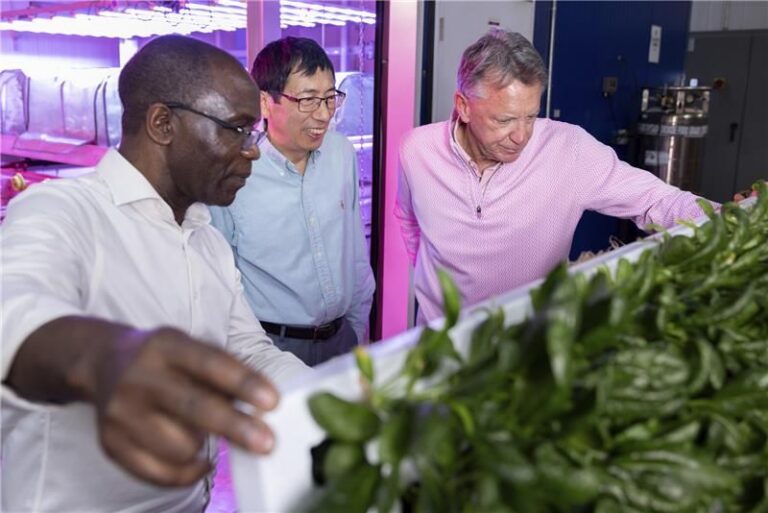
Newton has spent his career solving problems for world-changing companies. A native of Malawi with a PhD in agronomy from Purdue, he’s led research projects for Driscoll’s, Altria, and BP. At Infinite Acres, he’s helping plants reach their full potential through the right combination of genetics and environment.
A grow recipe includes everything from the plant nutrition you provide to how much light you provide—what spectrum, how much day length—to how you manage water and irrigation. Many of these things happen naturally when you grow outside, but indoors, you have to recreate them. Then, you fine-tune them so the plant is performing at the best possible capacity based on its genetics. That’s a grow recipe.
Spinach is a good example. When you grow spinach indoors, you can get good yields, but one of the issues you often see is leaf curling, which is unmarketable. By modifying the light spectrum, you can prevent that. In tomatoes, if you change light intensity, you change the balance of sweetness and acidity. In lettuce, changing air flow can eliminate the glossiness you see in some varieties.
Yes! Mint was a recent one. We thought one grow recipe would work for all mints. But the recipe we developed for peppermint didn’t work for Japanese mint. We had to go back and change the day length, light intensity, and irrigation frequency for Japanese mint to grow properly.
It comes down to genetics. Peppermint and Japanese mint produce different metabolites, so the recipe has to be different. And this is not unique to mint—we see the same thing with tomatoes. They all look similar, but some varieties are more prone to disease under certain conditions than others. Until you try them, you don’t really know how they’ll respond.
Well, we try to be as objective as possible with our work, which means using data to make our decisions. For tomatoes, for example, we don’t just measure yield—we track fruit size, shine, sweetness, acidity. Then we taste-test with consumers. That data loops back into our recipes and even into the economics of scaling up. Without that kind of data, which most farmers don’t have, we’d be working blind.
Today’s consumers are very sophisticated. Plant science is helping us meet and anticipate their needs. With molecular tools and markers, we can screen thousands of plants and key in on the best performers. Instead of waiting years, we can move faster and more precisely.
Wayne Gretzky said the difference between a good hockey player and the best hockey player is that the good player plays where the puck is, and the best player plays where the puck is going to be. As plant scientists, we have to play where the consumer is going to be and produce what they’re going to want to pay for.